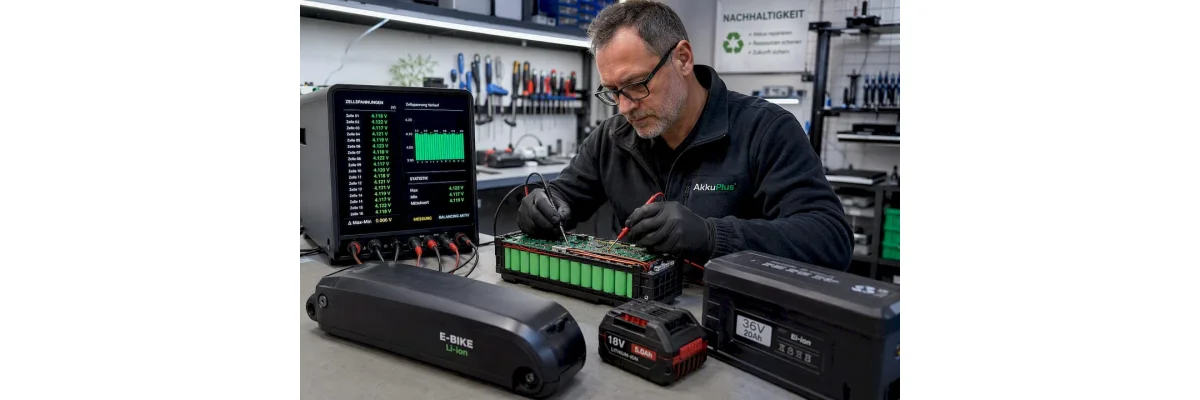


Measuring Battery Capacity: Methods, Devices, and Test Protocol
The most reliable method for measuring battery capacity is controlled constant-current discharge — all other methods provide estimates or trend indicators, not true capacity values. In this process, the battery is discharged at a defined current down to the cut-off voltage, and the removed charge is calculated using the formula Capacity (Ah) = Current (A) × Time (h). The result is reproducible, standards-compliant, and can be directly evaluated as State of Health (SoH).
For a quick field check, two alternatives are sufficient:
· Internal resistance measurement (mΩ): Provides an aging indicator within seconds. The trend over several measurements is more meaningful than a single value.
· Voltage test under load: A sharp voltage drop under load indicates high internal resistance or cell aging — but it is not a substitute for a discharge test.
A digital multimeter (DMM) is sufficient for basic diagnostics and a manual discharge test with a known load. For direct mAh values, you need a capacity meter or battery analyzer. Important: every measurement is valid only if the battery has acclimatized at 20–25 °C and is fully charged. A warm or partially discharged battery significantly distorts the result.
Which measuring devices and requirements do you need?
If you want to test battery capacity, you do not necessarily need expensive equipment. The right choice depends on the application.
Basic devices:
· Digital multimeter (DMM): Measures voltage and current; sufficient for manual discharge tests and basic checks. Devices from Fluke, Uni-T, or Brymen are widely used in Germany.
· Electronic load or load resistor: Required for a controlled discharge test with constant current.
· Capacity meter / battery tester: Automates the charge/discharge cycle and displays mAh directly. Ideal for 18650 cells and standard batteries; an affordable battery tester is completely sufficient for hobby users.
· Internal resistance meter: Devices from Hioki or Fluke measure in milliseconds; useful for regular condition checks.
· Charger with discharge function: Combines charging and testing in one step.
Accessories and prerequisites:
· Cables with sufficient cross-section, safe cell holders, temperature measuring device
· Battery data sheet with nominal capacity, cut-off voltage, and maximum discharge current
· Measurement protocol (date, temperature, starting voltage, current, time)
Pro tip: Stabilize the battery for at least two hours at 20–25 °C before testing. Temperature fluctuations significantly distort capacity measurements — a battery at 10 °C shows significantly less capacity than at room temperature, even though it is the same cell.
Multimeter, capacity meter, or internal resistance meter: which one fits when?

The three common device classes differ fundamentally in what they actually measure.
Digital multimeter: Measures voltage and current, but does not total charge. Capacity cannot be determined directly with it — only indirectly via a manual discharge test with a stopwatch and calculator. Useful for troubleshooting, voltage checks, and as a supplement to other devices.
Electronic load / capacity meter: This is the industry standard. The device keeps the discharge current constant, automatically totals the removed charge, and displays the mAh value directly. Specialized battery testers save time and considerably reduce manual errors. For 18650 cells, testers are available from around €20–30; for battery packs and professional applications, electronic loads start at around €100, while analyzers cost significantly more.
Internal resistance meter: Provides a value in milliohms (mΩ) within seconds. It is not a direct capacity value, but a reliable early aging indicator. What matters is the trend over time, not the individual value.
Coulomb counter / BMS readout: Ideal for embedded systems such as power tools, e-bikes, or laptops. The BMS estimates capacity based on a model — useful in everyday use, but it should be periodically calibrated with a real discharge test.
|
Device |
Measures directly |
Accuracy |
Typical use |
|
Digital multimeter |
Voltage, current |
Low (indirect) |
Basic check, troubleshooting |
|
Capacity meter / battery tester |
Ah / mAh |
High |
18650, standard cells |
|
Electronic load + DMM |
Ah (manual) |
Medium |
Single cells, DIY |
|
Professional analyzer |
Ah, SoH, IR |
Very high |
Battery packs, industry |
|
Internal resistance meter |
mΩ |
High (trend) |
Regular monitoring |
|
BMS / software |
SoC, SoH (model) |
Medium |
Smartphones, laptops |
Pro tip: A simple device is sufficient for an LCD battery tester for standard cells and button cells. Anyone who regularly tests 18650 cells or power tool batteries should invest in a dedicated capacity tester.
Step by step: measuring battery capacity by constant-current discharge
The following test protocol applies to lithium-ion batteries and is reproducible. Follow the steps consistently so that comparative measurements over time remain meaningful.
1. Check the data sheet: Note the nominal capacity (e.g., 2,500 mAh), cut-off voltage (typically 2.5–3.0 V for Li-ion), maximum discharge current, and recommended discharge rate (usually 0.2 C).
2. Acclimatize the battery: Store it for at least two hours at 20–25 °C. Document the temperature.
3. Fully charge: Charge the battery with a suitable charger up to the final charge voltage (typically 4.2 V per cell for Li-ion). Wait for balancing until the charging current has dropped to the maintenance charge current.
4. Observe resting time: After charging, wait at least 30 minutes so the voltage can stabilize (resting voltage / open-circuit voltage).
5. Define test parameters: Discharge current = 0.2 C (example: for 2,500 mAh → 500 mA), cut-off voltage, and prepare protocol fields.
6. Start discharge: Apply constant current and note the start time. Record voltage and temperature at regular intervals.
7. Switch off at cut-off voltage: The device or BMS ends the discharge automatically; alternatively, monitor manually and stop when the cut-off voltage is reached.
8. Calculate capacity: Ah = current (A) × time (h). Example: 0.5 A × 4.8 h = 2.4 Ah (2,400 mAh).
9. Calculate SoH: SoH (%) = measured capacity ÷ nominal capacity × 100. Example: 2,400 mAh ÷ 2,500 mAh × 100 = 96% SoH.
10. Document the result: Enter date, temperature, starting voltage, final voltage, current, time, calculated capacity, and SoH in the protocol.
Avoid measurement errors:
|
Error source |
Effect |
Countermeasure |
|
Fluctuating discharge current |
Distorted Ah total |
Electronic load with constant-current mode |
|
Contact resistance at high currents |
Voltage measurement error |
Use 4-wire measurement (Kelvin) |
|
Incorrect temperature |
Capacity too low |
Standardize to 20–25 °C |
|
Test started too soon after charging |
Excessively high starting voltage |
Observe 30 min resting time |
|
Varying C-rate in comparisons |
Values not comparable |
Always use the same discharge rate |

Quick tests: internal resistance, load voltage, and simple field methods
Sometimes a full discharge test is not necessary. These methods qualify a battery for further testing or provide quick indications of its condition.
· Internal resistance measurement: An internal resistance meter provides an mΩ value within seconds. What matters is not the absolute value, but the increase compared with the initial value at commissioning. Rising internal resistance indicates aging, often before capacity measurably decreases.
· Voltage test under load: Measure the open-circuit voltage, then apply a load and observe the voltage drop. A sharp drop (more than 0.3–0.5 V under low load) indicates high internal resistance or cell damage. Open-circuit voltage alone says nothing about available capacity.
· DIY capacity estimate with resistor and multimeter: For 18650 cells, this method works: charge the cell, connect a known resistor, measure the time until cut-off voltage, and calculate Ah. Less accurate than a dedicated tester, but possible without special equipment.
· BMS or software readout: For smartphones and laptops, the operating system often displays an SoH value. Android devices offer device-specific menu paths and codes for capacity checks; these values are model-based and should be verified by a real discharge test if in doubt.
Pro tip: Quick tests determine whether deeper testing is necessary. Anyone approving a battery for a critical application should never rely solely on open-circuit voltage — a battery can show perfect voltage at rest and collapse immediately under load.
Interpreting measurement results correctly: SoH, internal resistance, and replacement decision
A numerical value alone is not enough. Only in context does the measurement lead to a meaningful recommendation.

SoH ranges as guidance:
|
SoH (%) |
Assessment |
Recommendation |
|
Above 90% |
Very good (almost new) |
Continue using |
|
80% |
Good |
Continue using, keep monitoring |
|
70–80% |
Acceptable |
Test more frequently; consider replacement for critical devices |
|
< 70% |
Weak |
Replacement recommended |
· SoC vs. SoH: State of Charge (SoC) shows how full the battery currently is. SoH shows how much of the original capacity remains. A battery with 50% SoC and 85% SoH is half charged, but still in good condition.
· Internal resistance as an early warning: An increase in internal resistance to two to three times the initial value is a clear signal of advanced aging, even if SoH is still above 80%.
· Consider the application context: A battery with 75% SoH may still be usable for a flashlight. For a medical device or safety system, it is considered too weak.
Which factors influence measured capacity?
Same battery, different measurement value — this happens when test conditions are not standardized.
· Temperature: The strongest single factor. At 10 °C, measured capacity can be significantly below the value at 25 °C. Always measure at 20–25 °C.
· Discharge rate (C-rate): Higher currents reduce measured capacity. A battery with a nominal capacity of 2,500 mAh at 0.2 C delivers significantly less at 1 C. Varying C-rates make comparative measurements useless.
· Cycle count and age: Capacity gradually decreases with every charge/discharge cycle. Lithium-ion batteries also lose capacity through calendar aging even when not used.
· BMS condition and cell balance: An unbalanced cell pack (unbalanced BMS) shows a lower total capacity even though individual cells may still be good.
· Contact resistance and measurement setup: Poor contacts or thin cables cause voltage drops that distort the result. For high currents, 4-wire measurement is mandatory.
· Resting time before the test: A freshly charged battery without resting time shows a slightly elevated voltage. Wait at least 30 minutes.
Safety when measuring lithium-ion batteries
Li-ion batteries have high energy density. A mistake during testing can lead to overheating, venting, or fire.
· Never discharge unattended: Always remain present, especially with self-built test setups.
· Fire protection: Keep a fire extinguisher (CO₂ or powder) ready and test the battery on a non-combustible surface. For larger packs, a fireproof box or fire-resistant bag is recommended.
· Respect BMS protection functions: Never set test parameters beyond the limits specified in the data sheet. The BMS protects the cells — bypassing it risks deep discharge or overcurrent.
· Temperature monitoring: If cell temperature rises above 45 °C during the test, stop immediately. Permissible temperature ranges are listed in the data sheet.
· Electrical safety: Select cable cross-sections according to the discharge current; use fused current paths. For currents above 5 A, 4-wire measurement is standard.
· Do not test damaged batteries: Visible dents, swelling, corrosion, or electrolyte leakage are exclusion criteria. Such batteries belong at a collection point, not on the test bench.
Important note: Lithium-ion batteries must not be discharged below the manufacturer-specific cut-off voltage. Deep discharge permanently damages the cells and, in the worst case, can trigger thermal runaway. Always observe the cut-off voltage from the data sheet.
How long does a test take and what does it cost?
Time required:
· Full discharge test (including charging, balancing, resting time): typically half a working day to a full working day. At low discharge rates, the discharge takes several hours accordingly.
· Internal resistance measurement: less than one minute per cell.
· Quick check with multimeter: 5–10 minutes.
Device costs (approximate values):
· Simple battery tester for standard cells: from around €7–15
· Capacity tester for 18650 cells: €20–60
· Electronic load for single cells and small packs: €80–200
· Professional analyzers for battery packs: from €500, often significantly more
Service provider vs. self-measurement: An external testing service provides a calibrated protocol and assumes liability — and that has its price. For occasional tests on single cells or small packs, an affordable capacity tester is the more economical choice. Anyone who tests regularly will quickly amortize an analyzer. Capacity checks every 6 to 12 months are recommended for critical applications.
Why internal resistance trends often reveal more than a single capacity test
A full discharge test is accurate, but it is a snapshot. It shows the condition on one day under defined conditions. It is hardly suitable for continuous monitoring.
Internal resistance measurement works differently. It takes seconds, barely stresses the battery, and can be repeated weekly or monthly. Anyone who documents internal resistance from commissioning onward often detects aging trends earlier than a capacity test makes them visible. A sudden increase in the mΩ value can indicate emerging cell damage long before capacity measurably decreases.
This does not mean that discharge tests are unnecessary. The useful combination is regular internal resistance monitoring as an early-warning system, supplemented by periodic discharge testing to calibrate the SoH model. For industrial systems and critical infrastructure, this has long been standard practice.
Pro tip: Record the internal resistance of each cell or block at commissioning as a reference value. Only with this initial value can later measurements be interpreted meaningfully.
Key takeaways
The most reliable method for determining capacity remains constant-current discharge; internal resistance trends complement it as a fast early-warning system for everyday use.
|
Topic |
Details |
|
Most accurate measurement method |
Constant-current discharge (Ah = A × h) provides reproducible SoH values according to industry standards. |
|
SoH guide values |
Above 90% very good, 80% good, 70–80% acceptable, below 70% consider replacement. |
|
Standardize test conditions |
Maintain 20–25 °C, the same C-rate, and the same cut-off voltage for all comparative measurements. |
|
Internal resistance as early warning |
Document the trend from commissioning onward; an increase often indicates aging earlier than capacity loss. |
|
Akkuplus |
Offers battery testers, analyzers, and accessories for hobby and professional users throughout Europe. |
Which method for which battery?
For smartphones and laptops, the direct route through the system menu or a manufacturer tool is usually sufficient. The BMS provides an estimated SoH value that is good enough for everyday use. Only if the battery drains unusually quickly or the device shuts down unexpectedly is a full discharge test with an external load worthwhile.
For 18650 cells and similar small cells, a dedicated capacity tester is the first choice. The device automates the cycle, displays the mAh value directly, and costs little. Anyone sorting multiple cells or selecting them for projects cannot avoid using one.
Large battery packs for tools, e-bikes, or industrial systems require a different approach. Here, BMS monitoring is the daily basis, while the annual discharge test with an analyzer provides calibration. Documenting the internal resistance of each block from the start is not optional — it is the only way to detect aging trends in time. Anyone who starts doing this only when a block fails has already lost the advantage of early warning.
Suitable measuring devices and accessories at Akkuplus
Anyone looking for the right device will find a direct selection at Akkuplus without lengthy searching. For hobby users who want to test standard cells or button cells, an affordable battery tester from €6.78 is the fastest entry point. Anyone who regularly tests 18650 cells or power tool batteries will also find chargers with discharge function and the Akku Power Analyzer A36 at Akkuplus for precise, repeatable measurements.
Cables, cell holders, and safety accessories can be ordered at the same time. Akkuplus delivers throughout Europe and adjusts prices and availability regionally. Take a look at the product range directly and order the right device for your application.
Further sources and test protocols
For detailed protocols, standards, and practical instructions:
· Constant-current discharge and SoH calculation for lithium batteries — methodology, calculation examples, and temperature notes
· Internal resistance measurement as a diagnostic method — technical article on trend measurement and device comparison
· Professional guide: measuring battery capacity — limitations of the multimeter, comparison of capacity meters
· Measuring the capacity of 18650 batteries — step-by-step instructions for small cells and battery testers
· Testing a battery with a multimeter — RS Components guide to voltage, current, and internal resistance
· Checking battery capacity in Android — Vodafone how-to for menu paths and codes
· Akkuplus product catalog — battery testers, analyzers, and accessories for Europe
· For applications with battery-powered solar lights: solar lights and battery care — notes on battery performance outdoors